A Story That’s Not Hard To Swallow

San Juan Capistrano, California

Fiesta de Las Golondrinas

Close up view of the swallows nests

Close up view of the swallows nests

In 1776, while the English colonists were throwing down with the British in the east, Spain was having its way with the Acjachemen band of native Americans in the west, founding a mission in the place now known as San Juan Capistrano, California. San Juan Capistrano was the 7th mission founded in Alta California, and boasts the oldest structure still in use in California (the Serra Chapel). When the stone church was built (a departure from the adobe used in the other mission churches) it was one of the tallest structures in California, making its high walls an attractive substitute for the cliffs where the Cliff Swallows (Petrochelidon pyrrhonota) had built their homes for milennia. The swallows built their mud nests at the mission, flying off to the western coast of South America in the winter, returning again in the spring to procreate.

Ruins of the old stone church

Ruins of the old stone church

The mission inhabitants noted that the swallows “miraculously” returned to the mission on the Catholic feast day of Saint Joseph (March 19) each year, giving the event divine significance. Not being naturalists, they failed to realize that the reason the pagan feather dusters returned on March 19 was not because of Saint Joesph, but because of the vernal equinox – spring. Yes, spring, when thoughts of procreation filled their pointy little heads. Swallows reuse their nests year after year (not surprising knowing the amount of time it takes to make them, one beakful of mud at a time), so returning to the mission or any tall cliff-like structure where they had previously built their dream home is a foregone conclusion. The odd fact is that the individual bird does not reuse the same nest; the colony shares the nests, and it’s first-come, first-served. Their aerial dance when choosing their nests is a sight to behold; solo pilots drop out of the swirling cloud to claim the choice real estate. Read the rest of this entry »

Tags: , , , , , ,

Through The Looking Glass

Fort Bragg, California

Glass Beach

People scavenge for glass on Glass Beach

People scavenge for glass on Glass Beach

There are some places on earth that blur the distinction of what is natural and what is man-made; other places where mankind’s disregard for the environment results in the creation of a place of unusual beauty, where one man’s trash truly becomes another man’s treasure. One such place is Glass Beach, in California’s Mendocino County. In the 1940s, residents used this small stretch of shoreline as a dump, a practice unimaginable today. Household items were discarded into the sea, from bottles and dishes all the way up to old cars. In the 1960s, the dumping was stopped and the state closed the dump, making efforts to remove what large waste items they could – nature took care of the rest. Over the years, the surf rolled and pounded the trash against the rocks and tumbled them in the sand until there was not much more than pebble-sized items left. Since a great deal of the trash was glass, it is the primary component of the pebbles that cover the entire beach, giving the beach its recent name. Read the rest of this entry »

Tags: , , ,

I Think I’ll Go Eat Worms

Eat Bug Eat Event

Machine Project, Los Angeles, California

Cooking the wriggling superworms

Cooking the wriggling superworms

Miriam-Webster’s Dictionary defines a worm as “any of numerous relatively small elongated usually naked and soft-bodied animals (as a grub, pinworm, tapeworm, shipworm, or slowworm)”. In my mind, I picture the night crawlers I used to get to go fishing in Barton Creek, but since the term applies to the shape of these invertebrates, it also covers the creepy crawly larval stage of beetles, butterflies and moths. When I heard that Machine Project (a storefront space that experiments in technology, science, and the arts) was holding an event entitled “Eat Bug Eat”, I was intrigued. Although it sounds like the title of a Japanese monster movie, the event was held to educate people in the culture and custom of eating insects. Although I’d eaten insects many times before, from the crunchy snack-like hormigas culonas to the grassy-tasting silkworm pupae, I succumbed to the come-hither of wax moth larvae tacos. Read the rest of this entry »

Tags: , , , , , , , ,

There’s Always Room

Gelatin

United States, Great Britain and Asia

Coffee jello at Durgin Park in Boston

Coffee jello at Durgin Park in Boston

Oh, poor misunderstood gelatin! Anything resembling gelatin has been given the name “jello” by Americans (“jelly” by the British), although Jell-O is actually a trademark of one brand of commercially available gelatin. Gelatin in its pure form is clear and practically tasteless; it is typically manufactured by boiling down the bones, connective tissues, organs and the hides of cattle, pigs and/or horses in order to extract the collagen (sounds tasty, doesn’t it?). Surely you remember as a kid when mom boiled that ham for a New England boiled dinner, popping the remains into the fridge – when that door swung open the next day, voila! – gelatin. Serving just the gelatin became popular way back in the late 1800s, although it required the aforementioned cooking down process or buying dried gelatin sheets and purifying and reconstituting them, which quite frankly was a pain in the gluteus maximus. Commercially available powdered gelatin made dessert preparation easier because of two men – Peter Cooper who patented the process of powdering gelatin, and Charles Knox who created and marketed a pre-granulated gelatin. Pearle Wait (who bought Peter Cooper’s patent) added flavoring to the powdered gelatin in 1897 and began marketing it as Jell-O; Knox became known for his unflavored variety. To this day Jell-O (which was manufactured by General Foods) and Knox are both Kraft Foods brands, with Jell-O so popular that the governor of Utah declared it to be the state snack (take that, Illinois, with your stinkin’ popcorn). Read the rest of this entry »

Tags: , , , , , , , , , ,

King For A Day

Pismo Beach, California

Monarch Day

No expense spared to herald Monarch Day

No expense spared to herald Monarch Day

Europe has its crowned heads, and North America has is own monarchs – the Monarch butterfly. Probably the most recognizable butterfly in North America (or at least a close tie with the yellow and black tiger swallowtail), the Monarch’s reign ranges from the southernmost parts of Canada in the summer to Mexico. Unlike other American butterflies that can survive the cold weather, the Monarch migrates south to Mexico and in the west congregates north through California along the coast. One particular vacation paradise for the Monarchs is the Pismo Beach Monarch Grove, located in a thick stand of eucalyptus at the south end of the North Beach Campground. The Monarchs begin arriving in October, and the height of their population is at the beginning of February, prompting February 5th to be declared Monarch Day by the California State Legislature (California Western Monarch Day Bill/SCR 66). Read the rest of this entry »

Tags: , , , ,

Oh, Sandy!

Steele, North Dakota
World’s largest sandhill crane (Sandy)

A quick history of Sandy the sandhill crane

A quick history of Sandy the sandhill crane

In the race to build the superlative beast, it appears that the contest for world’s largest sandhill crane is down to a field of one. The 40-foot tall sheet metal avian (“Sandy”)  stands watching for tasty cars passing by on Interstate 94 (North Dakota’s big beast highway) in Steele, North Dakota. Easily visible from the highway, Sandy seems to have nested in an unlikely location. Unlike the fanfare for her bovine and bison counterparts, there are no billboards or gated parks that indicate her home. Sandy stands at the end of the giant gravel parking lot of the Lone Steer Motel Restaurant and Lounge, a place that would look at home in one of those movies where the car breaks down and you have to spend a creepy night. Sandy’s grassy plot is not conspicuously marked – there’s no entrance booth or path, just a couple of wooden kiosks describing the life and migratory habits of the sandhill crane. The park is populated with local plants, bushes and trees that were donated or purchased through a grant from the North Dakota Forestry Department. Read the rest of this entry »

Tags: , , , , ,

Cock-a-doodle-doo

Rooster Testicles

Mon Land Hot Pot City, San Gabriel, CA

Fresh rooster testicles

Fresh rooster testicles

Although I’ve never seen a rooster strutting around the barnyard “balls-out”, I was surprised to learn that they actually have testicles. As a food adventurer, it occurred to me that after having had just about every part of the chicken, I was missing out on this delicacy. Desperate to find them locally, I turned to friend, writer and fellow blogger Eddie Lin who had the balls to suggest Mon Land Hot Pot City in San Gabriel, California (and no, this is not the last of the puns). I enlisted Josh (Trippy Food’s webmaster and usual partner in crime), as well as a few friends to join me in San Gabriel for a sack lunch (I warned you).

Mon Land Hot Pot City - we sat outside

Mon Land Hot Pot City - we sat outside

Since it was a warm, sunny day we opted for the patio and were seated at a table with a stone top, a circular opening neatly cut into it (reminding me of a Korean BBQ). Instead of the familiar grill, our waitress placed a heating unit under the table and into the hole a huge metal bowl partitioned in the middle in the “ying/yang” style of Yunnan Province. One side was filled with a milky, beige broth and the other with a menacingly red one. These were heated to a rolling boil, and the steam coming off the liquid was pure, intoxicating, aromatic bliss. The red broth was spicy, with what appeared to be Tien Tsin chilies drowning in the oily abyss; both sides were flavored liberally with garlic, cloves, ginseng, ginger, goji berries and other unidentified spices. We had ordered our dishes from a pick list, and I was transfixed by the vapor when our food started to arrive. Read the rest of this entry »

Tags: , , , , , , ,

Toast’s Best Friend (Or Worst Enemy)

United Kingdom
Marmite

Marmite - Love it or Hate it

Marmite - Love it or Hate it

Over the years, I have had the pleasure and opportunity to savor unusual food from across the globe. I have enjoyed guinea pig at at a table where the other diners didn’t like the way the entree was looking at them; I have delighted in the rich, buttery taste of the spiky and odiferous durian, while others were gagging in the bushes. To this day people wonder what is my kryptonite, my gastronomic achilles heel. Surely, there is some food-like substance that has the power to ruin my breakfast. Your honor, ladies and gentlemen of the jury, let the record state that for the murder of my taste buds, I find the defendant – Marmite – guilty as charged. I’m sure I am going to catch some flak from some of my British counterparts for this, but this is to be expected. In fact, the official Marmite web site is split into two sections accessed from the home page – one for folks who love it, the other for those who hate it. Hate seems like a harsh term, but it adequately describes those who intensley dislike this crime against nature disguising itself as food. Marmite is a spread for toast that is the by-product of beer production; it is a sludge-like substance made from yeast extract. It has the consistency and stickiness of molasses and the taste of salted crankcase oil from an engine run for 100,000 miles. I don’t really have a point of reference here, never having salted crankcase oil, but I’m willing to bet I’m right. Read the rest of this entry »

Tags: , ,

O What A Glorious Sicht

Scotland, UK

Burns Night Supper

The guest of honor - the haggis

The guest of honor - the haggis

Few events celebrate both a famous poet and a national dish quite like the Scottish celebration that is the Burns Supper. The event is traditionally held on the birthday of “Scotland’s favorite son” and national poet, Robert Burns. Burns was born on January 25 in 1759 and on that night it is not uncommon throughout Scotland and other parts of the United Kingdom to gather to memorialize not only Burns, but also haggis, the national dish of Scotland he made famous. The annual Burns Supper generally follows a particular structure, with the dish immortalized in Burns’ “Address to a Haggis” being the guest of honor. A true Scotsman would either be touched by Burbank’s Buchanan Arms holding a Burns Supper, or recoil in horror of having Americans give it a go for olde Rabbie Burns. Read the rest of this entry »

Tags: , , , , , , , ,

Ice Water In Their Veins

Wall, South Dakota
Wall Drug

The sprawling cluster of buildings that make up Wall Drug

The sprawling cluster of buildings that make up Wall Drug

Have you ever been in traffic, maybe in Boston, Chicago or Atlanta and noticed a Wall Drug bumper sticker on one of the cars in front of you? Perhaps you’ve wondered, “What is this Wall Drug, and why does a drug store have bumper stickers?” The fact of the matter is that Wall Drug is a variety of things, least of which is a drug store. Part of its mystery and allure may come from the fact that it’s pretty far from anywhere. To find Wall Drug you’d have to either plan a trip out through the badlands of South Dakota or just happen to be passing through on Interstate 90. It’s impossible to ignore the signs along the highway for hundreds of miles in either direction, beckoning like The Thing on Interstate 10 in Arizona. Since there’s really nothing else around for miles, it almost makes sense to stop, which is exactly what Nebraskan pharmacist Ted Hustead and his wife Dorothy realized when they bought a little drug store in Wall, South Dakota back in 1931. What took a little time was to figure out how to get the lines of people heading down Interstate 90 to see the relatively new Mount Rushmore to stop in their little town. It was Dorothy who hit upon the idea to offer travelers free ice water, and as the saying goes, if you build it they will come. Billboards on the highway attracted travelers and business got so good that they grew from a storefront drug store to what amounts to a rustic, western-themed mall and entertainment complex encompassing an entire city block. Read the rest of this entry »

Tags: , , ,

In Defense Of The Twinkie

Deep fried Twinkies
The Chip Shop (New York City), The Dessert Factory (Pasadena, CA)

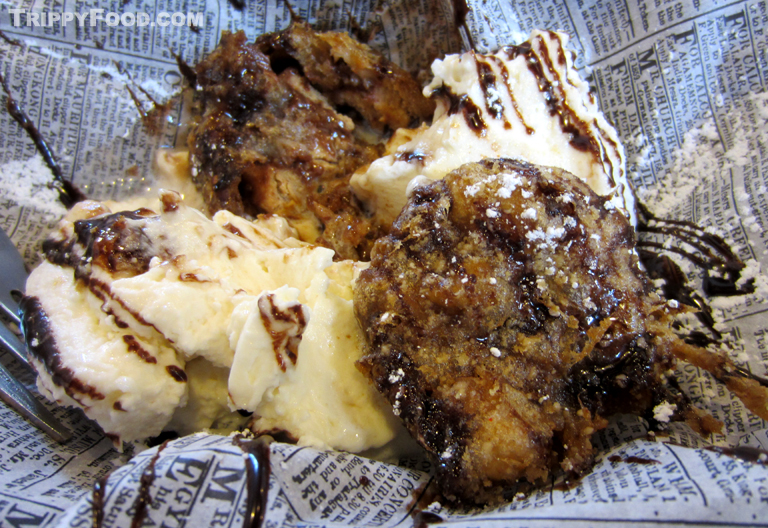
The taste sensation sweeping the nation - fried Twinkie

The taste sensation sweeping the nation - fried Twinkie

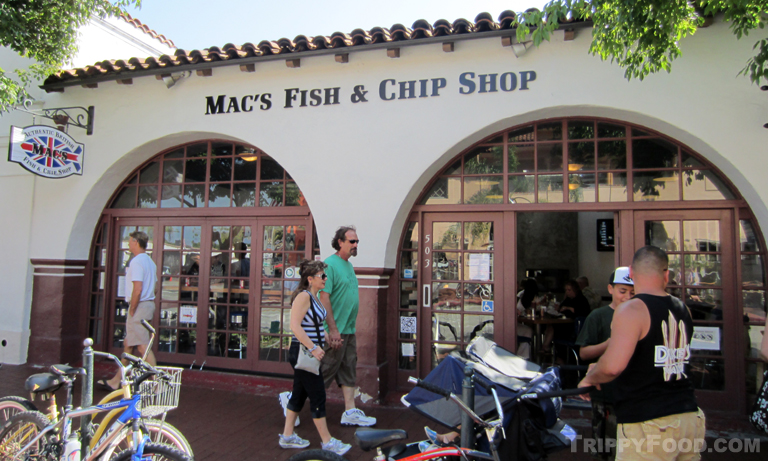
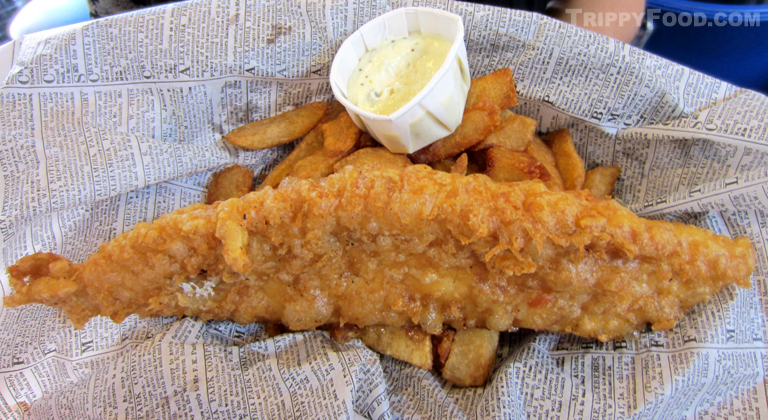
How can something so wrong be so right? Just the thought of eating a Twinkie sends a chemically-induced sugar rush up the back of my spine, so what would prompt me to brave the cellophane-wrapped snack that looks like Sponge Bob’s coffin? The opportunity to have it deep-fried. There was still a high degree of risk, but I wanted to see what the frying process did to make this foam brick from Hell edible (or more inedible). The invention of the deep fried Twinkie in 1992 is said to be attributed Shea Apple, a transplant from Great Britain who opened a chip shop in Brooklyn, New York (appropriately named “The Chip Shop”). Unlike your neighborhood chip shop (or “chippy” in the UK), The Chip Shop batters and fries everything that will survive the Frialator including pizza, macaroni and cheese, and Mars Bars. After experimenting with various snack items, he found the Twinkie to fry up quite nicely. They use the same batter used for frying fish (for the fish and chips); it is served sliced lengthwise, dusted with powdered sugar, sitting on a berry sauce-drizzled plate. Read the rest of this entry »

Tags: , , , , , ,

Spam, Wonderful Spam!

SPAM (Honolulu, Hawaii and Austin, Texas)

SPAM, wonderful SPAM

SPAM, wonderful SPAM

What do you mean, “Ech”? I’m not sure where Spam gets its bad reputation; perhaps it’s because it comes in a can. Food snobs turn their nose up at it, likening it to the meat version of Cheez Whiz. Even the great food explorer Andrew Zimmern expresses his disdain for it. You know a food is feared when people prefer blowfish to it, but Spam also generates somewhat of a cult following. We’ll talk about where Spam gets elevated to cause célèbre status, but first let’s discuss its humble origin. Spam was originally made by Hormel Foods of Austin, Minnesota way back in 1937. Although alternating versions of the name attribute it to an alliteration of “Shoulder of Pork and hAM” or the simpler “SPiced HAM”, Hormel maintains that the name is an adjective, and insists that it is spelled with all upper-case letters. One of my personal favorite plays on the acronym is “Something Posing As Meat.” The ingredients state it is chopped pork shoulder with added ham meat. It gained a surge in popularity during World War II, especially in Hawaii where fresh meat was difficult to come by. American soldiers ate it with most of their meals, and it continues to be eaten by more Hawaiians that anywhere else on earth per capita. As I discovered on a trip to Austin, Minnesota (for non-Spam purposes), you can smell it throughout the town (those of you living near Heinz in Pittsburgh or General Foods in Woburn, Massachusetts know what I’m talking about). Read the rest of this entry »

Tags: , , , , , , , ,

Postcards From Hell

Hell, Michigan

Greetings from sunny Hell

Greetings from sunny Hell

What could give your bragging about having been to Hell and back more street cred than a trip to Hell, Michigan? Think about the joy of having a point of reference the next time someone says, “It’s hotter than Hell today”, or to truly know what a snowball’s chance there is. Don’t let the name fool you – although it would be fun to provide pictures of Death Valley or Kilauea and let you believe this is what Hell looks like, this couldn’t be farther from the truth; I would liken parts of nearby Detroit as more befitting the name of Hell. The tiny town is about 20 miles from Ann Arbor as the crow flies (you can substitute a raven if you’d like) and as is true of much of that region of the Midwest it is relatively flat. The drive takes you through picturesque green rolling pasture and farmland, and while the road to Hell is assumed to be paved with good intentions, I am sorry to report that it is smooth, well-kept asphalt – not even brimstone! Read the rest of this entry »

Tags: , ,

Tastes As Great As Its Name

Alhambra, California
Stinky tofu and blood soup (Lee’s Garden)

Stinky tofu, no further description needed

Stinky tofu, no further description needed

Think of the gleeful cries of joy when you tell the kids to get in the Wagon Queen Family Truckster for a road trip to get some stinky tofu just like momma used to make. I know, the wave of excitement is indescribable, after all, who wouldn’t want to try the Taiwanese taste treat without having to fly there? If this sounds like you, then I have the answer to your culinary prayers at Lee’s Garden in Alhambra, California. Lee’s Garden is in a storefront of a strip mall that you might drive past several times without realizing it’s there. Hui, a friend who turns us on to some amazing and unusual Chinese cuisine told us about the place and mentioned that they had other food unusual to our Western sensibilities that we might enjoy. The sign is slightly smaller than its next door neighbor, Dr. Lee’s Family Dentistry – I’m not sure if there is a link between the two but I feel not knowing in this case makes me a happier person. Inside is a testament to simplicity – no cork sculptures or laminated panels on the wall here, just tables, chairs and a hand-written menu on a big whiteboard that changes daily. We knew we wanted an order of the stinky tofu (which was listed on the menu as “fried odor bean curd”, a delectable title to be sure), but when I saw pork blood soup and chitterlings with garlic sauce I was sold. Read the rest of this entry »

Tags: , , , , , ,

Right Is Right And Left Is Wrong

Pasadena, California
Fork in the Road

The fork in the road at the fork in the road

The fork in the road at the fork in the road

The road to life often forks, leaving you to wonder which path to take. At the intersections of Pasadena Avenue and St. John Avenue in Pasadena, California you can only go right, but you may want to linger for a bit to admire the fork itself. Local artist Ken Marshall erected an 18-foot tall steel-reinforced wooden fork at the intersection of the two streets as a prank for the birthday of The Ice House founder Bob Stane’s 75th birthday during Halloween in 2009. A permit is required when erecting public art in Pasadena, but men dressed as CalTrans workers erected the sculpture surreptitiously in the middle of the night. Pasadena’s mayor has expressed no desire to have it removed, noting that it brings people to the area and has a positive impact on the community, but the traffic island is under the jurisdiction of CalTrans and may eventually have to be removed. The fork is painted silver, but the fact that it is made of wood may make it temporary anyway.

You can eat a lot of meat with this fork

You can eat a lot of meat with this fork

The fork is not the first of its kind, nor is it the largest. In 2000, artist Stephen Schreiber created a 31-foot tall fork from steel and aluminum, also located at a fork in the road in Milan, New York. A giant steel fork in Springfield, Missouri stands outside an ad agency – it was originally in front of an Italian restaurant but purchased and moved when the restaurant went out of business. Although probably the largest fork in the world, it is disqualified here since it not only doesn’t stand at a fork in the road, but also is hidden behind the building. The Pasadena fork can safely be called the largest wooden fork in the world. Recently a food drive was successfully conducted at the site of the fork, and with all the positive publicity it will probably be around for awhile, or at least until they’re told to get the fork out of here.

Forks in the Road:
Intersection of Pasadena and St. John Avenues
Pasadena, CA 91105
GPS coordinates: 34°7′51.81″N 118°9′17.27″W

Intersection of New York 199 and New York 308
Milan, NY 12571
GPS coordinates: 41°58′13.52″N 73°49′15.23″W

Large fork:
2215 W Chesterfield Blvd.
Springfield, MO 65807
GPS coordinates: 37°8′43.49″N 93°19′23.81″W

Tags: , , ,